“But we’re not a normal narrowboat.”
Kilsby Diary
Tuesday 3rd March 2026
Kilsby and Lion
Banbury to Aynho Wharf, and return leg for Lion
By Jack Pritchard
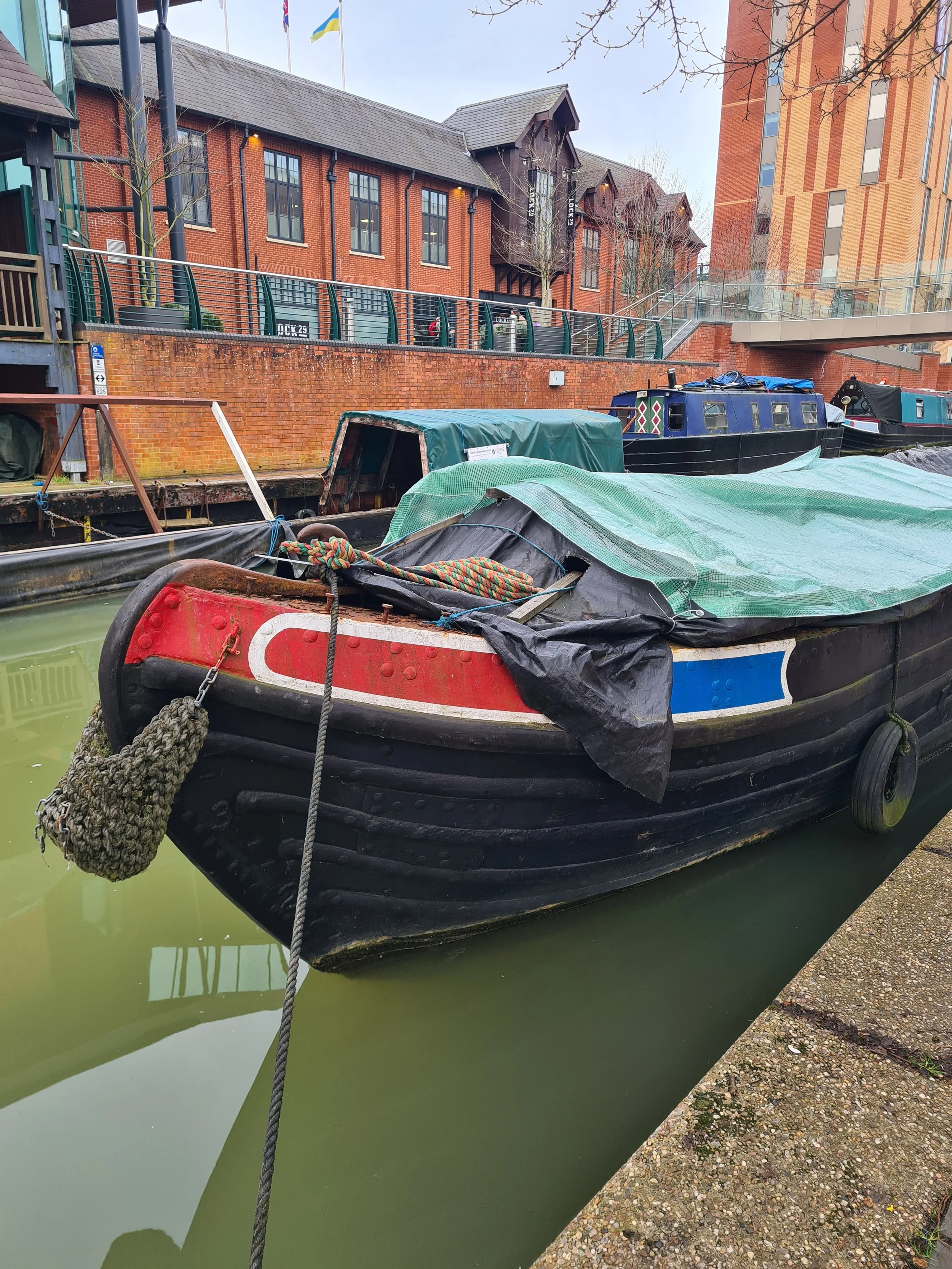
Kilsby in Banbury, just about to begin the journey south to Aynho.
The Plan for the Day
It’s Tuesday morning. Narrowboat Kilsbyis moored in Banbury, near Tooley’s Boatyard. On Friday morning, a crane and a truck are going to come to lift Kilsby and take her to the boatyard at Dadford’s Wharf (near Stourbridge, west of Birmingham). However, it’s not possible to crane a boat onto a truck at Banbury, so we need to get Kilsby down to Aynho Wharf before then. Kilsby doesn’t currently have an engine, so we’ll be relying on Lion, a 1940s tugboat to provide the power for the voyage.
According to the canal route-planning website, Banbury to Aynho Wharf is a journey of 6 miles and 6½ furlongs, with one liftbridge and 5 locks along the way. At normal narrowboat speeds it says the journey should take 4 hours and 8 minutes. But we’re not a normal narrowboat.
We expect the locks to be slow going. Four of the five are narrow locks, and we think the combined length of Kilsby and Lion is longer than the space inside the lock, by about three feet. This means we’ll need to work every lock twice. First we’ll need to get Kilsby down the lock, haul Kilsby out by ropes, then refill the lock, and operate it again for Lion. We’ll then reconnect the cables between the two boats before we can continue the journey. So although it’s only five locks on the map, we’re expecting to do nine lock-passes. That's a lot of windlass-winding and gate-pushing.
The Day
We met at Tooley’s Boatyard at 8am. Crewing the tugboat we had Richard and Jake from Tooley’s, and cycling alongside ready to take photographs and work the locks were Marta and Jack.
When towing on the canals, the powered boat usually goes in front and the engineless boat (in pairs of working boats, called ‘the butty’) is towed along behind. In this setup, a steerer is needed on each vessel. However, Lion is a ‘push tug’ so the arrangement is different. The push tug sits behind the butty, and the boats are physically connected by tensioned cables. This means that the two effectively operate as one very long craft, with one steerer at the back controlling both boats together.
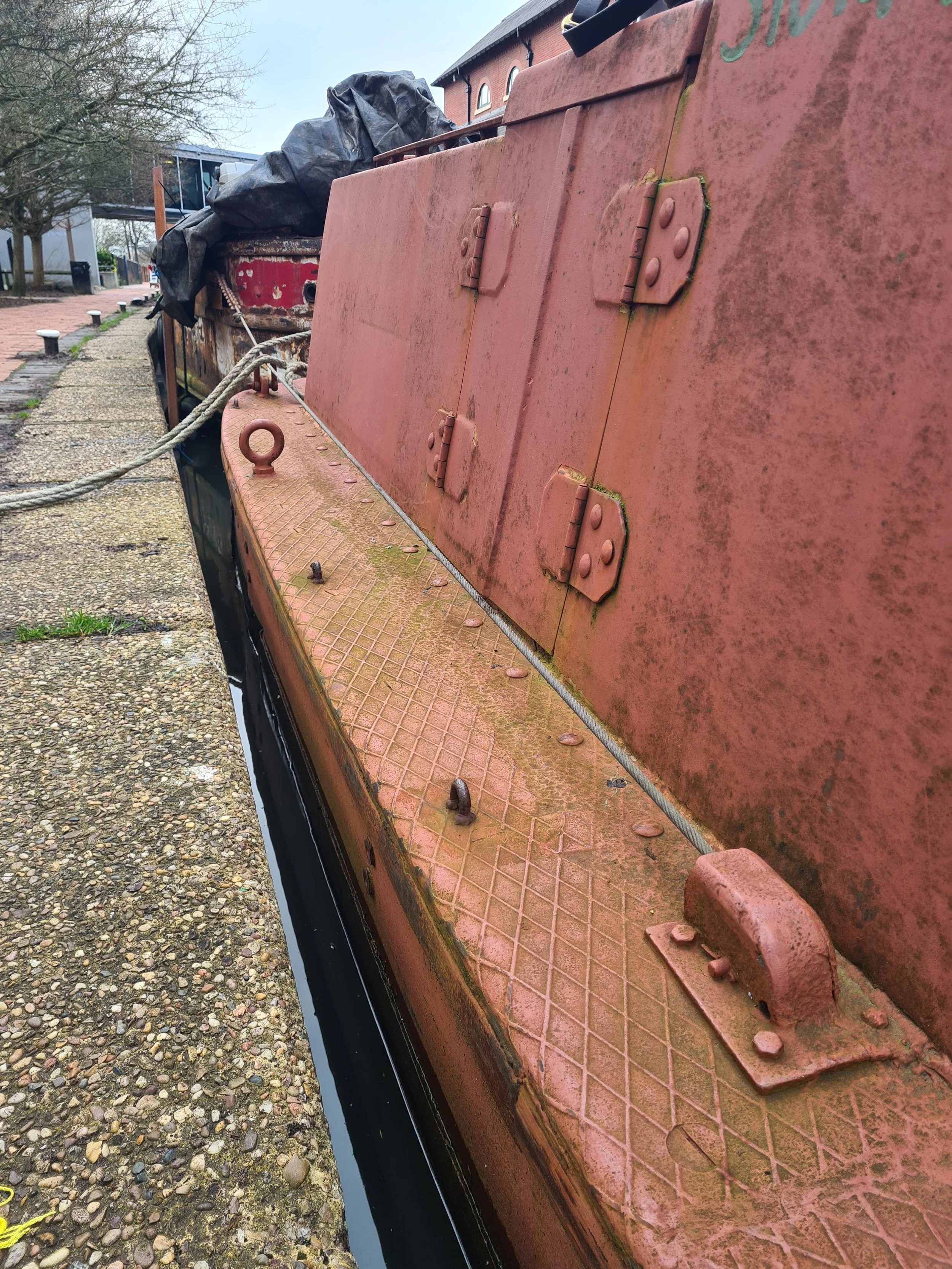
Lion is fastened to Kilsby
After a safety briefing from Jake, we were ready to get going. Despite ominous forecasts in the days beforehand, it was delightful boating weather - warm and sunny, with no wind. The perfect spring day, and something of a disappointment for those who wanted to come back with dramatic stories about battling against the elements.
Lion pushed Kilsby into the first lock, Richard disconnected the cables, then reversed out. We emptied the lock of water, opened the bottom gates, and then (as planned) tried to manually pull Kilsby out on the rope. But she wouldn’t budge forward and seemed completely stuck.
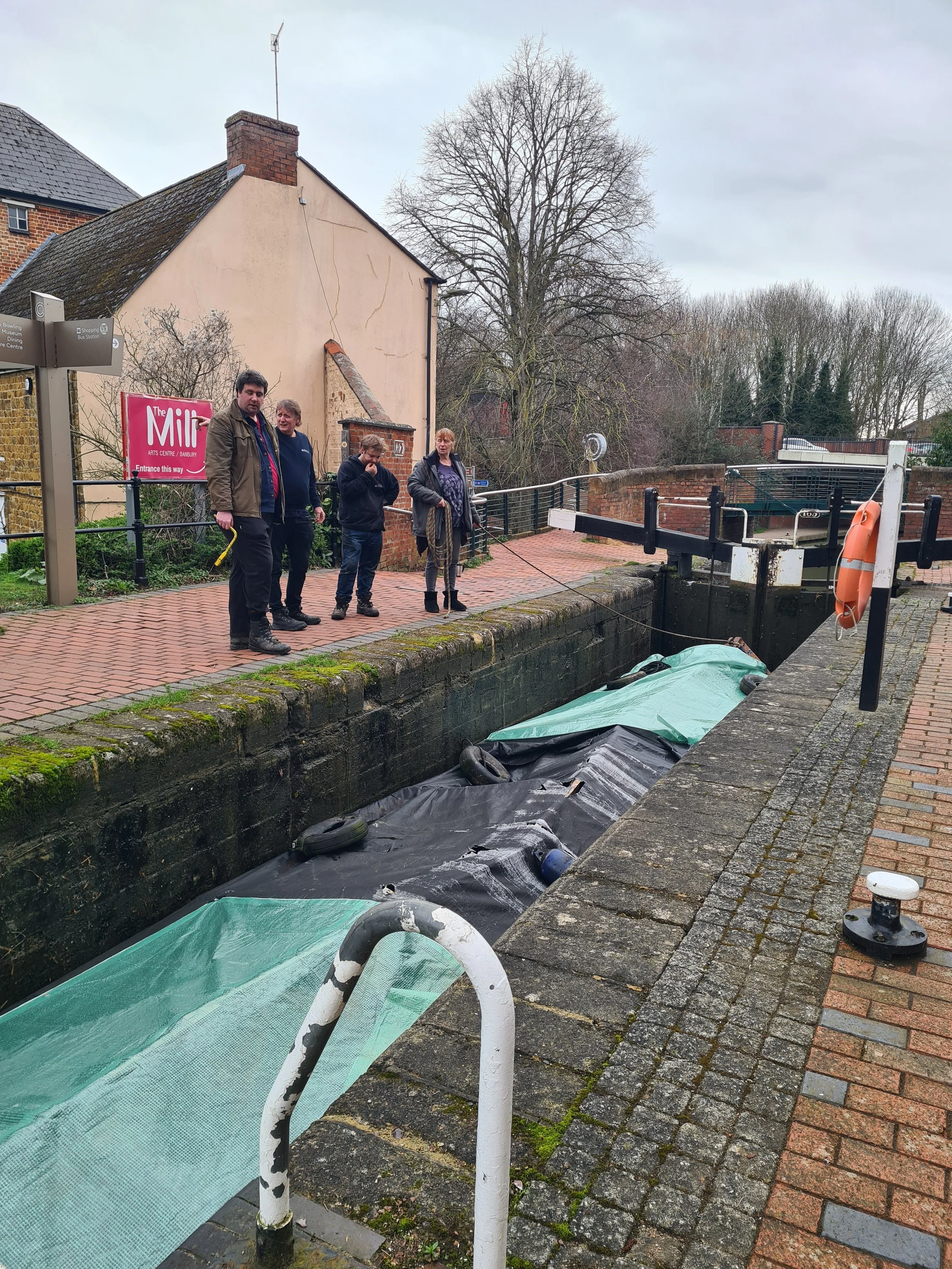
Jack, Matt, Jake and Kate contemplate Kilsby’s wedged predicament
There were a number of options we could have tried here. The obvious was to just get a load of people to haul on the rope and brute-force Kilsby out. This could possibly have been combined with opening the paddles on the top gate, to get an additional ‘push’ from the water flowing through. But even if we succeeded with this method to get through Banbury Lock, we knew we’d likely encounter exactly the same problem at all the other narrow locks along the route. And once we were away from Banbury, we wouldn’t have a helpful crowd of onlookers who could potentially be cajoled into lending their strength to the rope, nor the tools and expertise of a nearby boatyard. We needed not only to solve the immediate problem, but also make sure the same issue wouldn’t occur later.
The first thing we tried taught me something new about historic working boats. When narrowboats are filled with coal, the weight of the coal causes the steel of the boat hull to deform slightly: the sides spread outwards, making the boat slightly wider. On seagoing boats and river boats this wouldn’t be much of a problem. But with the tight tolerances of canal locks, it was very important to limit the ‘spread’: a boat that spread too much might become too wide to fit through the locks.
To counter the issue of spreading, boats built as butties (including Kilsby) have a series of sturdy fixing points fitted along the inside of their hulls. Special chains can be hooked into a point on either side of the boat, and are put under tension with a turnbuckle. The tension pulls the sides of the boat together and prevents any further spread. Two chains were fetched from Tooley’s, expertly affixed to the hull and then tightened. But even with them in place, the boat still would not move out of the lock.
The issue was the hat. When we knew that Kilsby’s hull would be spending some years moored outdoors in Banbury, a wood-and-tarpaulin structure was built over the top to stop her filling up with rain. This structure was variously referred to as ‘the hat’, ‘the lid’ or ‘the roof’.
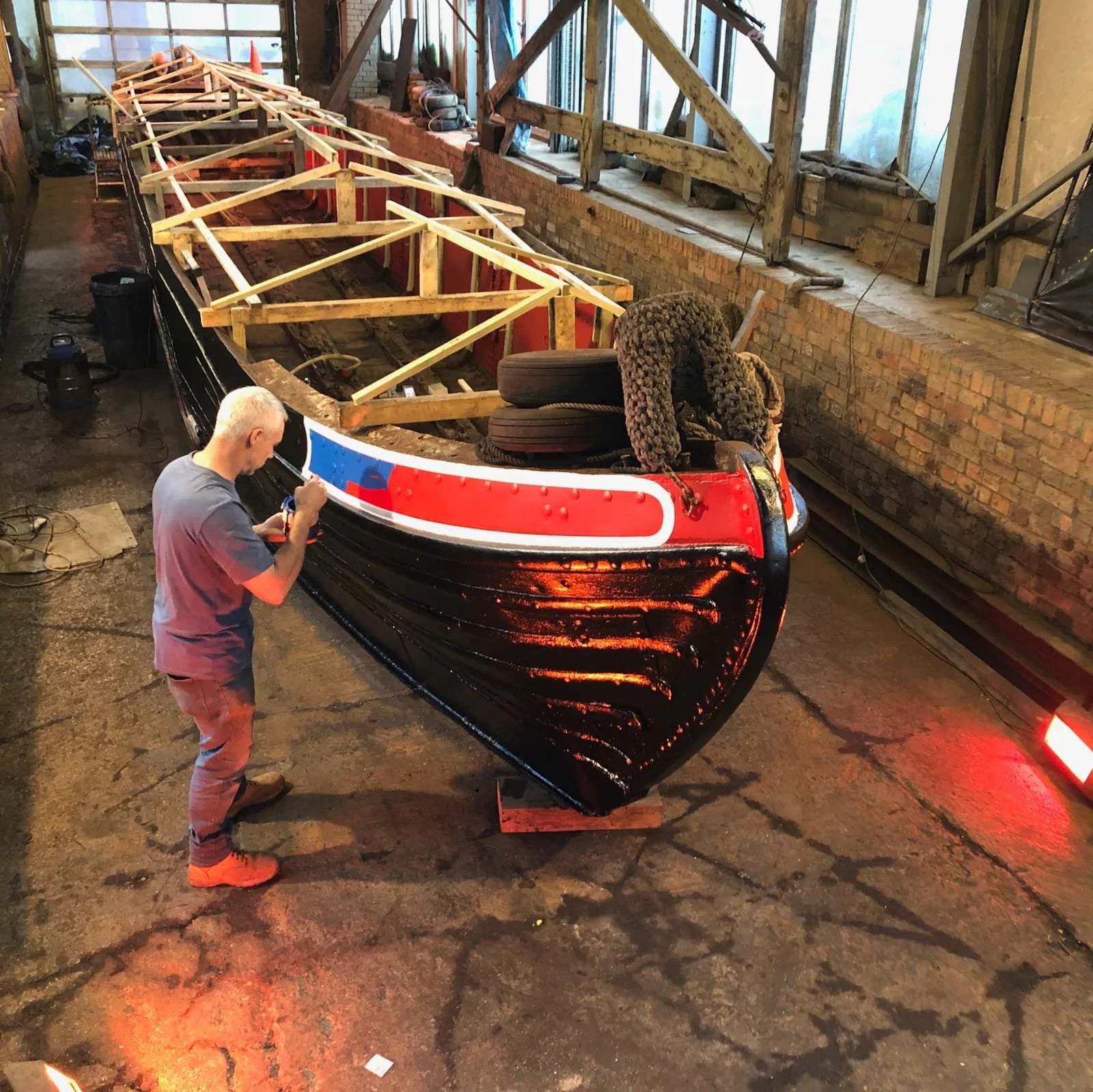
‘The hat’ in Tooley’s dry dock. It was expertly built by the late, great Kilsby volunteer Steve Watts.
To serve its purpose of directing rain out of the hull, ‘the hat’ had eaves which overhung the edges of the boat. And it was these eaves which were now catching on the inside of the lock wall. After some discussion, we closed the gate and refilled the lock, bringing Kilsby back up to ground level. Then, with saws, crowbars, and other implements of destruction fetched from Tooley’s, we set about demolishing the roof. It was a sturdily built construction and had served Kilsby well, but it needed to be removed if we wanted to progress through the lock.
“We’re conserving a historic narrowboat from 1912,” I explained to a bemused cyclist who had stopped to watch, as volunteers and boatyard employees smashed up the frame behind me.
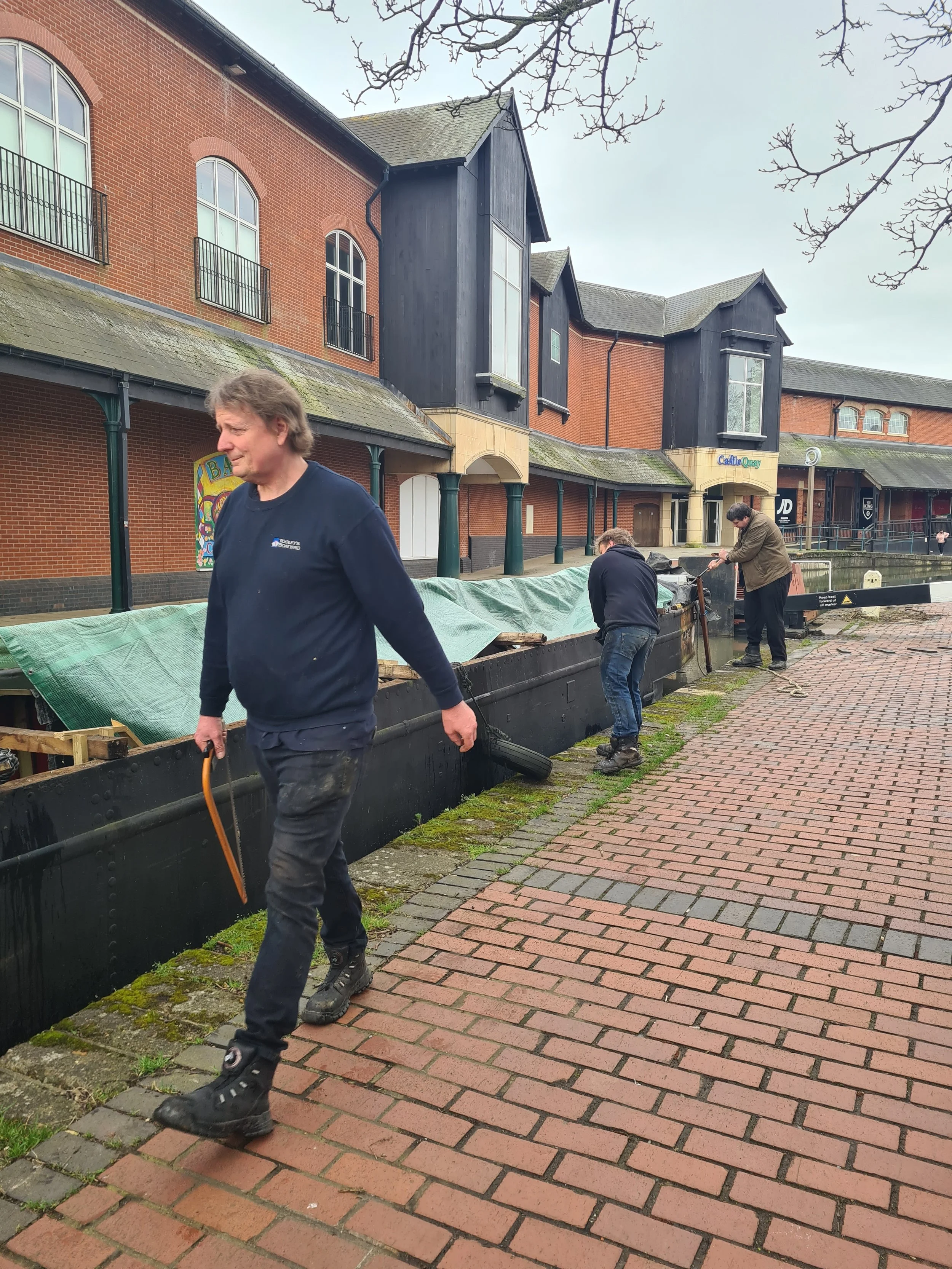
Matt, Jake and Jack deconstruct ‘the hat’
We did this work while Kilsby was in the lock, fully prepared to make space if another boat approached the lock. Keeping in the lock meant that we could access and work on both sides simultaneously. Kate, a boater moored nearby (and Kilsby volunteer), described how a local boatyard many years ago used to use the lock in a similar way - but they were far less accommodating to boaters wanting to pass through.
By the time the hat had been demolished enough for it to sit fully inside the boat, it was around 9:30. We had travelled a total of about 150 metres in an hour and a half, and still had a long way to go.
Before lowering the water level in the lock again, Richard wondered if there might, somehow, be space to get Lion into the lock as well. And, to our delight, we had been wrong somewhere in our earlier measurement or calculations. The two boats did fit into the lock together. So, despite the delay of the hat-demolition, our workload for the day was now halved - we would only need to operate each narrow lock once. Hooray!
The two boats made steady progress out of Banbury. Jack and Marta cycled ahead, stopping to take photos and video of the boats, and to watch a kestrel hunting in the meadows near the canalside housing development on the southern edge of Banbury. We stopped at Nadkey Bridge (bridge 170) to take photos from above as the boats passed underneath us. South of Banbury the towpath was surprisingly dry, despite it being the end of one of the rainiest winters ever recorded - we were mostly cycling rather than pushing bikes through the mud (as I’d feared we would be). And we hurried on down, under the M40 bridge, to get the next lock set ready for when the boats arrived.
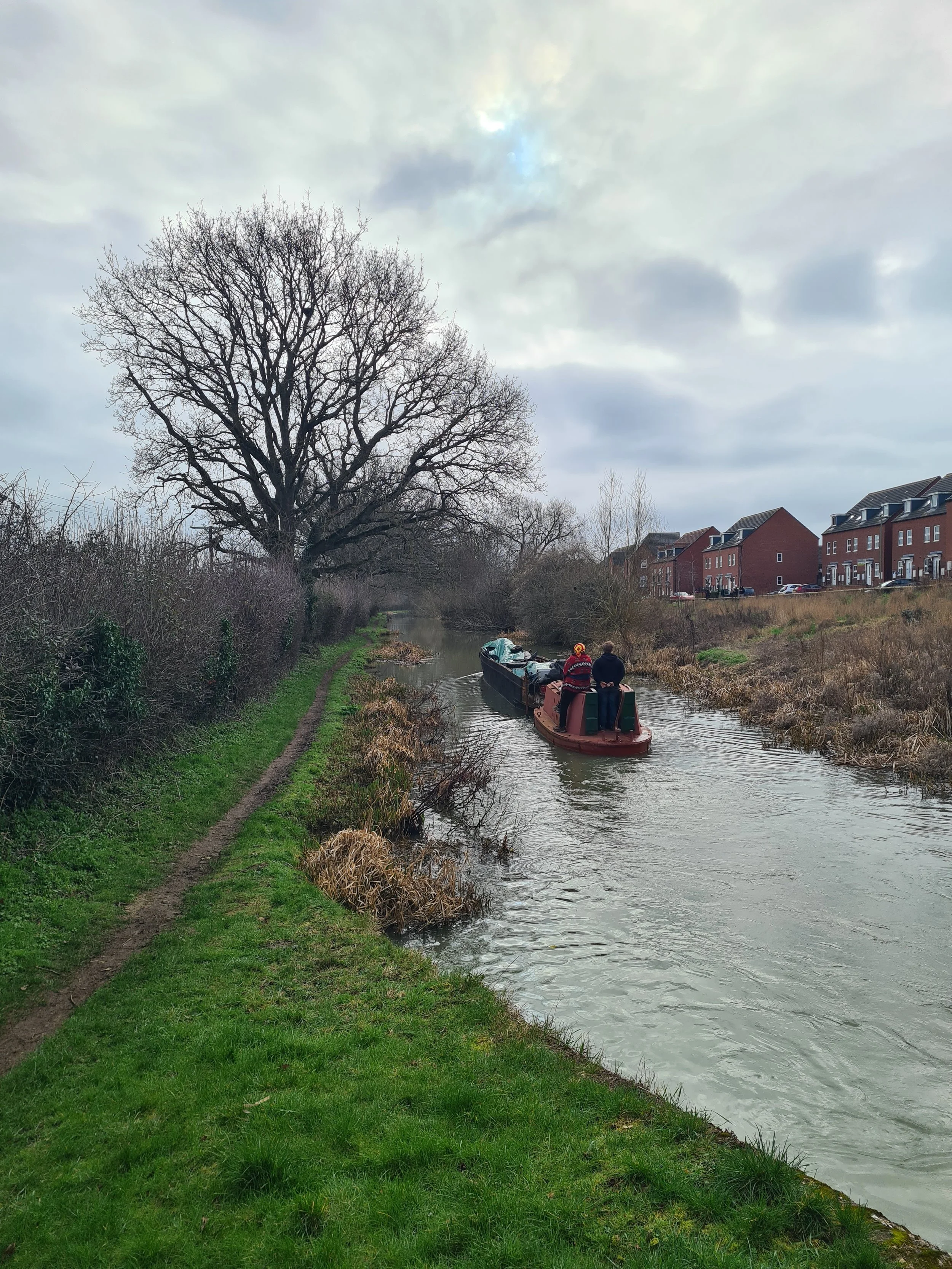
Lion pushes Kilsby down the canal, Jake and Richard at the tiller
Passage through Grant’s Lock (Lock 30) at about 10:30, without incident. Again, both boats fitted in together so we only needed to operate the lock once.
Passage through King’s Sutton Lock (Lock 31) at about 11:20, without incident. South of King’s Sutton Lock there was lots of flooding in the surrounding fields, and the towpath became considerably more muddy. From that point, it was as much pushing bicycles through the mud as actually cycling them, but we could still stay comfortably ahead of the boats.
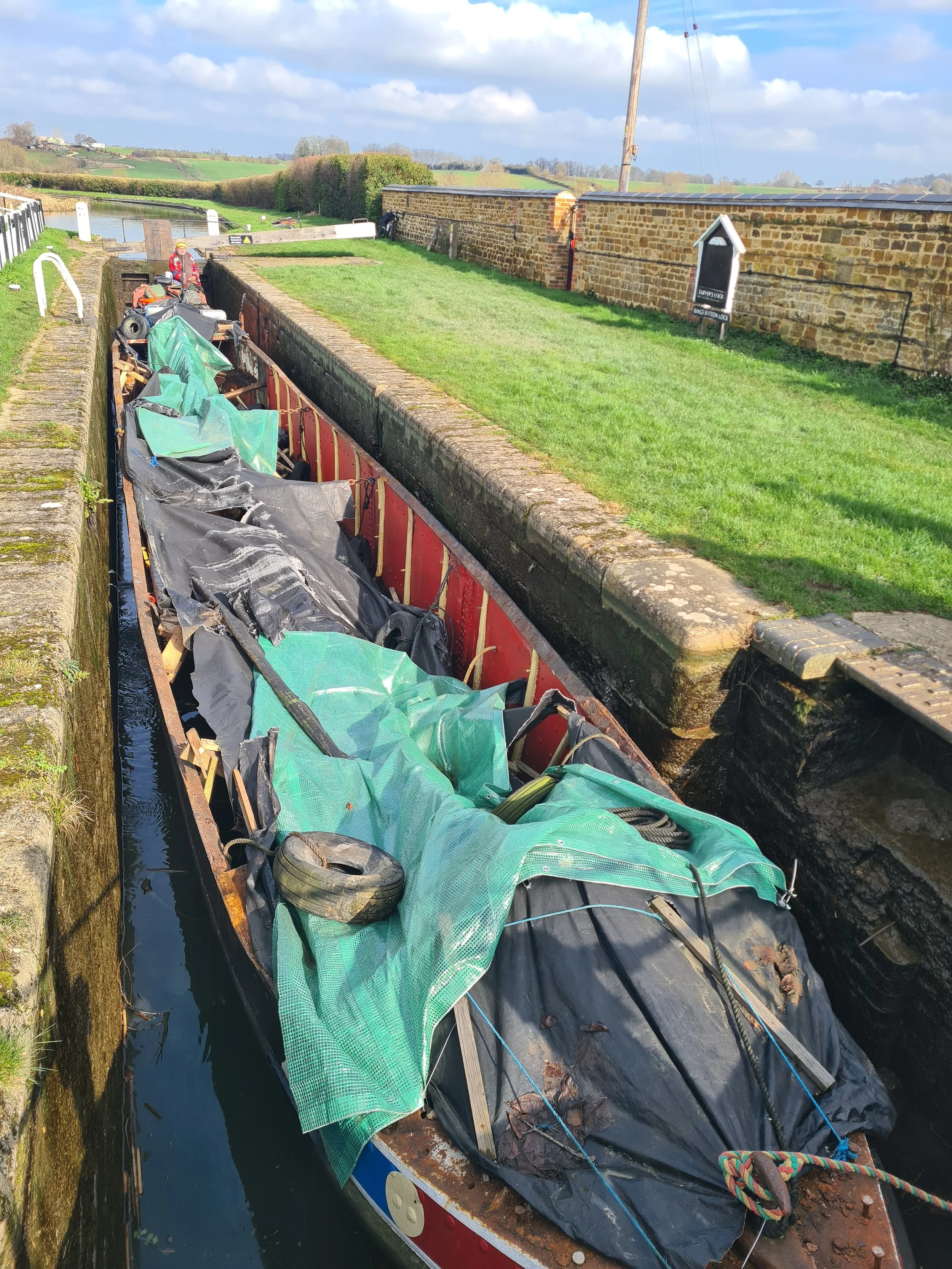
Lion, Kilsby and Richard in Kings Sutton Lock
Arrived at Nell Bridge Lock just after midday. Again, both boats fitted into the lock and we emptied the water, as we’d done at the two previous locks. However, there then wasn’t enough room to open the gate at the bottom end - the laws of mathematics finally caught up with us and decided to apply: the boats were too long, and the gate wouldn’t open without catching on Kilsby’s nose. We tried lifting the front fender, pulling Kilsby tight against one side, and adjusting Lion to a slightly diagonal angle to make the most of the space. But despite our best efforts, it was still a few inches too long. The only thing to do was refill the lock, reverse Lion out, and then take the two boats through separately, refilling the lock in between. Slow work, but the only way to get through.
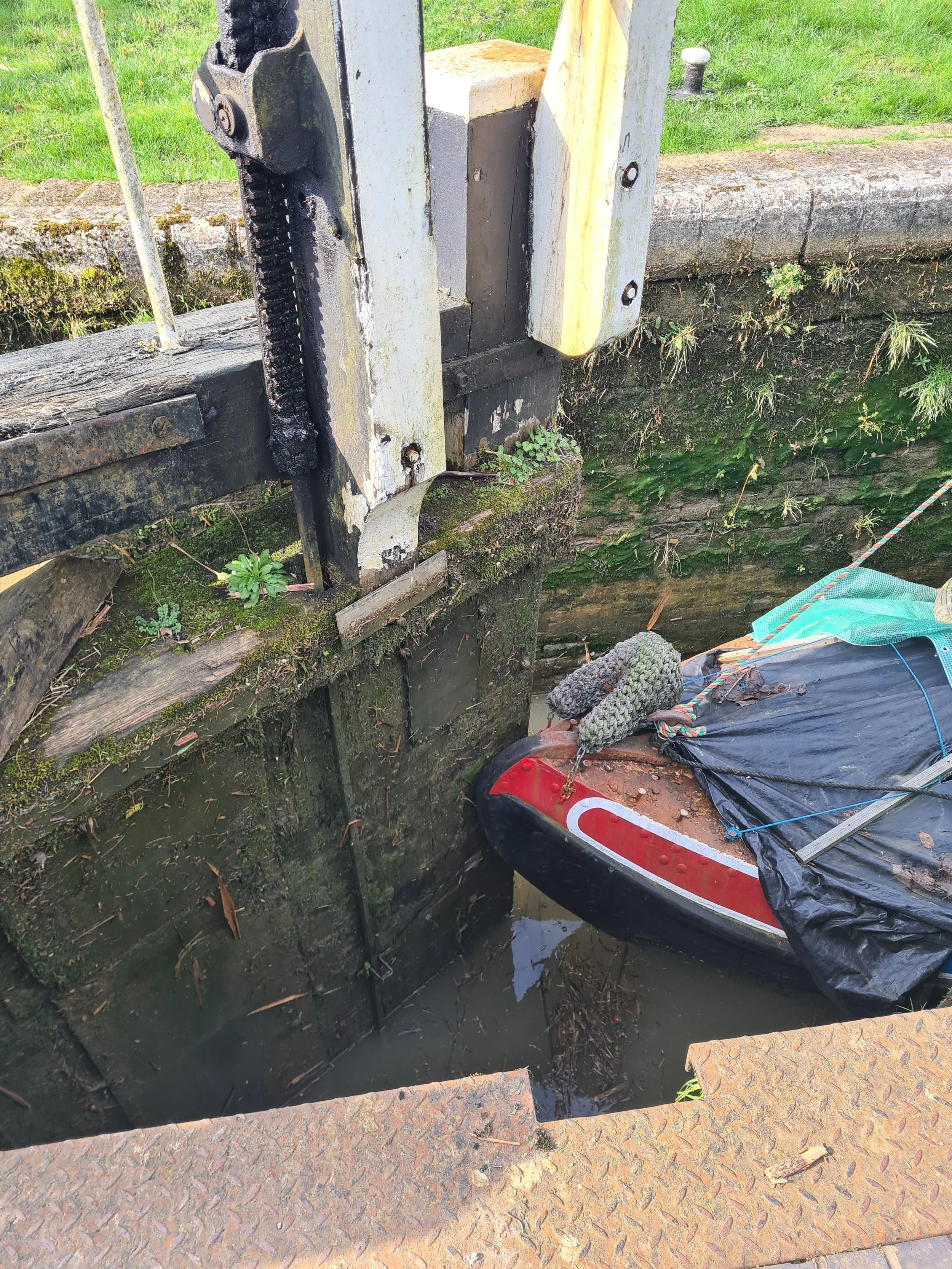
Nell Bridge Lock gate catches on Kilsby’s nose
Passage through Aynho Weir Lock (the diamond-shaped one) was very soon after (about 13:20). The two boats fitted lengthways, with plenty of room for the gate to open. This lock is very wide, so if they had not fitted we could have disconnected the cables and positioned them side-by-side, but we didn’t need to do this.
Then a run straight down to Aynho Wharf. The cyclists went down to scope out potential moorings near Aynho Wharf, but we needn’t have worried: there was plenty of space, and we moored directly opposite the carpark where the crane will come in.
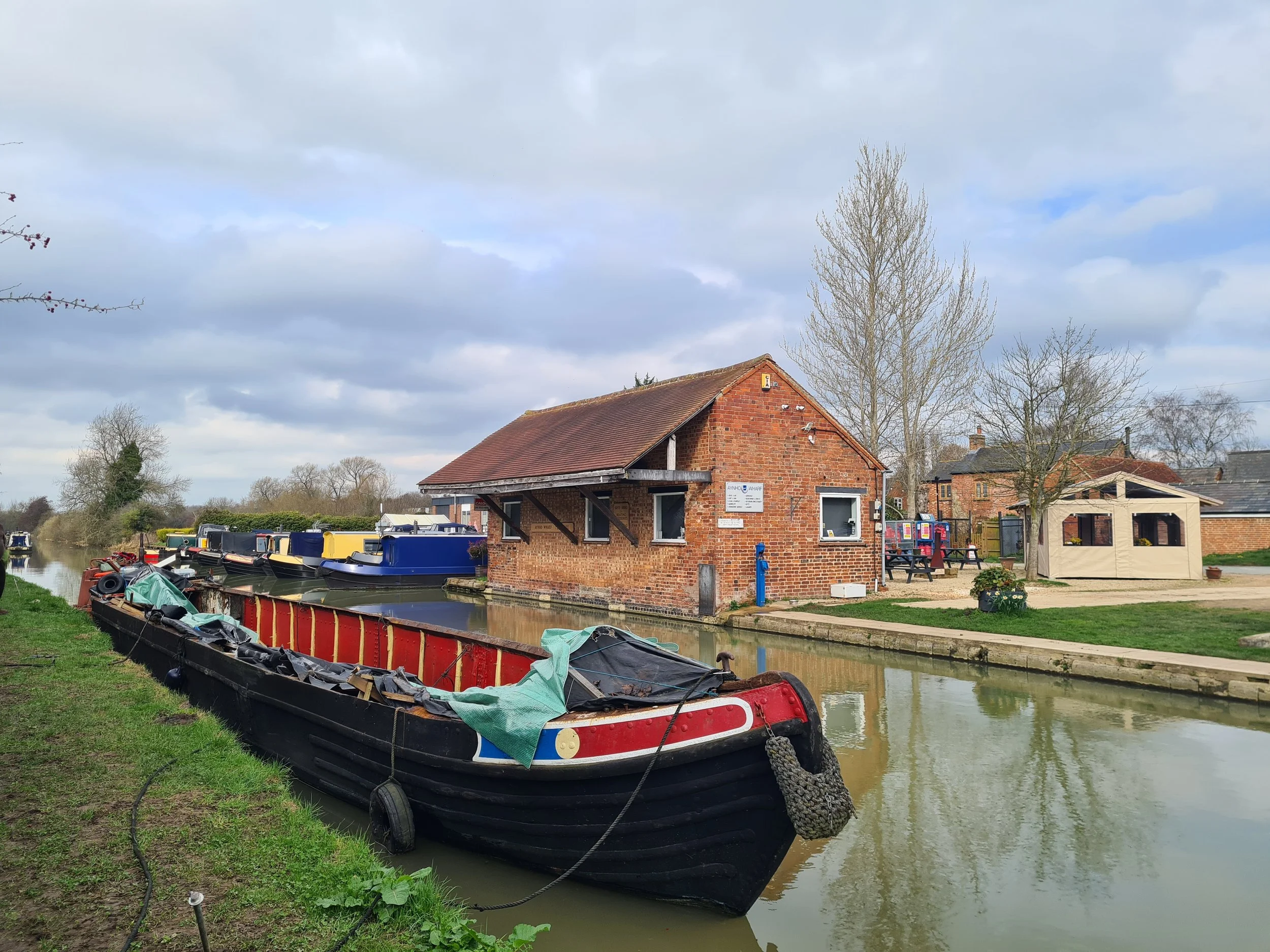
Kilsby moored up at Aynho Wharf
Disconnected Lion and moored Kilsby. All moored up by around 14:15, and made the decision to get Lion back to Banbury.
Journey back went without incident. Jack and Marta helped with the first two locks, Marta diverted off after Nell Bridge Lock to catch a train from King’s Sutton. Jack carried on to Banbury, helping with the final locks.
Overall very quiet on the water all day. We passed one small boat heading north near Twyford Wharf, and another came into Aynho Weir lock as we came out (on our return leg), but I think they were the only others moving.
Lion safely moored at Banbury at 17:30.